


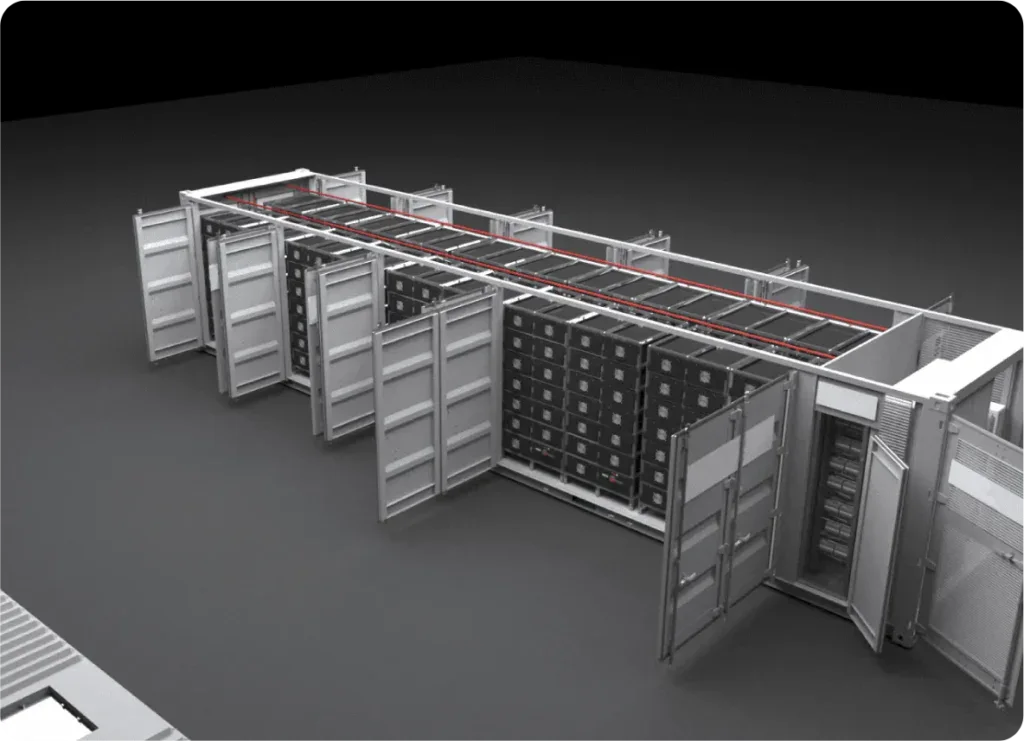
As global demand for battery energy storage systems (BESS) accelerates, the industry is facing a critical challenge: how to scale massive storage deployments while keeping costs, efficiency losses, and operational complexity under control.
Increasingly, the answer lies in cascading high-voltage architecture.
Energy companies and storage manufacturers are turning toward higher-voltage system designs to improve efficiency, reduce infrastructure costs, and support the next generation of grid-scale energy storage projects.
Why Voltage Matters in Energy Storage
In battery systems, voltage directly affects how electricity is transmitted throughout the system.
Higher voltage allows the same amount of power to move with lower current, which reduces:
- Heat generation
- Energy losses
- Cable thickness requirements
- Cooling demands
- Overall system inefficiencies
This becomes especially important as storage projects scale from megawatt-hours to gigawatt-hour deployments.
Traditional lower-voltage systems can become increasingly inefficient and expensive at larger scales because they require more cabling, more conversion equipment, and more thermal management infrastructure.
What “Cascading High Voltage” Means
Cascading high-voltage architecture refers to connecting battery modules and power conversion systems in layered high-voltage configurations rather than relying on heavily centralized low-voltage aggregation.
In practice, this means:
- Battery racks operate at higher DC voltages
- Fewer conversion stages are required
- Energy flows more efficiently across the system
- Power electronics can be simplified
- Large storage arrays become easier to scale
The approach is gaining traction in utility-scale storage projects where efficiency gains of even a few percentage points can significantly improve long-term profitability.
Lower Costs, Higher Efficiency
One of the biggest advantages of high-voltage cascading systems is lower balance-of-system cost.
By reducing current flow requirements, operators can use:
- Smaller copper cabling
- Fewer inverters
- Reduced cooling infrastructure
- Simpler electrical layouts
That can substantially reduce both capital expenditure (CapEx) and operational expenditure (OpEx).
According to industry analyses, higher-voltage architectures can also improve round-trip efficiency, helping storage operators maximize revenue from electricity trading, peak shaving, and renewable integration. (energy-storage.news)
Designed for the Renewable Energy Era
The rapid expansion of solar and wind generation is increasing the need for large-scale storage systems capable of stabilizing intermittent renewable power.
Battery storage is increasingly being used for:
- Grid balancing
- Frequency regulation
- Renewable energy shifting
- Backup power
- Industrial energy management
As projects become larger and more complex, scalable high-voltage design is becoming a competitive advantage rather than a niche engineering choice.
Companies such as CATL, Tesla, and BYD are all investing heavily in next-generation storage architectures optimized for higher energy density and utility-scale deployment.
Safety and System Management Remain Critical
Despite the advantages, higher-voltage systems also introduce new engineering and safety requirements.
Operators must carefully manage:
- Electrical isolation
- Thermal runaway prevention
- Fault detection
- Fire suppression
- Battery management systems (BMS)
Advanced monitoring software and intelligent power management are becoming essential components of modern storage platforms.
Industry experts say future profitability in battery storage will depend not only on battery chemistry, but also on system architecture and power electronics design.
The Future of Energy Storage Is Bigger — and Higher Voltage
Global energy storage deployment is expected to expand dramatically over the next decade as countries modernize power grids and accelerate renewable adoption.
In that environment, profitability increasingly depends on scalability and efficiency.
Cascading high-voltage systems are emerging as one of the key engineering strategies that could enable the next wave of large-scale, economically viable energy storage infrastructure.